
Article I, department 5, of the U.S. Constitution provides that "Each Firm [of Congress] may determine the Rules of its proceedings, punish its members for disorderly behavior, and, with the concurrence of two-thirds, expel a member." Censure is a form of bailiwick used past the Senate against its members (sometimes referred to as condemnation or denouncement). A formal statement of disapproval, a censure does non remove a senator from office. Since 1789 the Senate has censured nine of its members.

The United States Constitution gives each house of Congress the power to be the judge of the "elections, returns, and qualifications of its own members" (Article I, section 5). Since 1789 the Senate has carefully guarded this prerogative and has developed its own procedures for judging the qualifications of its members and settling contested elections.
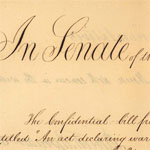
The Constitution grants Congress the sole power to declare war. Congress has declared state of war on eleven occasions, including its first declaration of war with United kingdom in 1812. Congress approved its last formal declaration of war during World War Ii. Since that time it has agreed to resolutions authorizing the use of military force and continues to shape U.S. war machine policy through appropriations and oversight.

Article I, section v, of the U.Southward. Constitution provides that each house of Congress may "punish its members for disorderly behavior, and, with the concurrence of ii-thirds, expel a member." Since 1789 the Senate has expelled merely 15 members.

The Senate has a long history of using the filibuster—a term dating back to the 1850s in the Us—to delay debate or block legislation. Unlimited fence remained in place in the Senate until 1917, when the Senate adopted Rule 22 that immune the Senate to terminate a debate with a two-thirds bulk vote—a procedure known as "cloture." In 1975 the Senate reduced the number of votes required for cloture from two-thirds (67) to three-fifths (60) of the 100-member Senate.

Under the Constitution, the House of Representatives has the power to impeach a government official, in consequence serving as prosecutor. The Senate has the sole ability to carry impeachment trials, substantially serving as jury and judge. Since 1789 the Senate has tried 20 federal officials, including three presidents.

Congress has conducted investigations of malfeasance in the executive branch—and elsewhere in American club—since 1792. The need for congressional investigation remains a disquisitional ingredient for restraining government and educating the public.

The Constitution provides that the president "shall nominate, and by and with the Advice and Consent of the Senate, shall appoint Ambassadors, other public Ministers and Consuls, Judges of the Supreme Court, and all other Officers of the United States… (Commodity 2, Section two)." The Senate has always jealously guarded its power to review and approve or turn down presidential appointees to executive and judicial branch posts.
The Senate is governed by the Constitution, a set of standing rules, precedents established in the course of the legislative process, and special rules of procedure adopted past statute for particular types of legislation. These rules determine how bills and resolutions are moved towards passage, the structure of Senate committees, how argue gain on the chamber flooring, and how members bandage votes.
The Constitution gives the Senate the power to corroborate, by a two-thirds vote, treaties made by the executive branch. The Senate has rejected relatively few of the hundreds of treaties it has considered, although many have died in committee or been withdrawn by the president. The Senate may too improve a treaty or prefer changes to a treaty. The president may also enter into executive agreements with strange nations that are not subject to Senate approving.
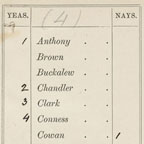
The Senate takes action on bills, resolutions, amendments, motions, nominations, and treaties by voting. Senators vote in a diversity of ways, including roll call votes, vocalism votes, and unanimous consent.
0 Response to "Can the Senate Force the Houae of Reprenatives to Do Things"
Postar um comentário